

Andrea Mollá and Kikemaiden.
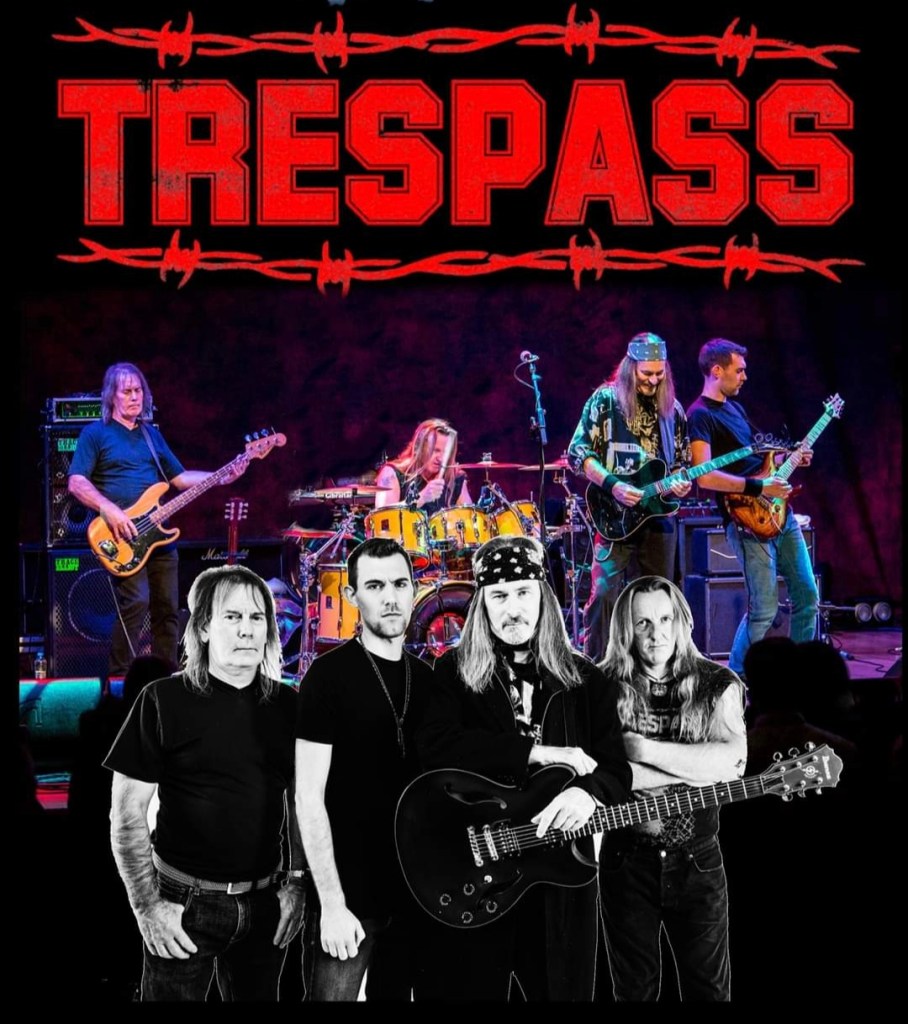
Trespass is one of the forgotten bands of the movement NWOBHM, hidden because they were short-lived in their time and released little official material. But as has been happening in the last few years, it is a band that is working, in a humble but insistent way, a place in the past as well as in the present. For all this, besides talking about «Wolf at the door», which they are about to release, they drop by these metal pages.
REA- In the first place, it is a pleasure to have a band with a history like yours in the Rock entre amigos podcast.
It is a pleasure to share some memories and thoughts of the future with you!
REA- Trespass was born in 1978, when Heavy Metal was taking its first steps and the British scene was starting to show another side of rock different from punk. Why did you come up with the idea of forming a rock band? How old were you? What was Suffolk like musically?
Suffolk was a real backwater. We used to joke that it was an area stars retired to! Actually we were only 100km or so from central London!
I was 19 in 78 my brother Paul was only 17. I always wanted a guitar but could only afford one when I left school and started work at 16 in 1975. At the same time I met some new friends who were big rock fans. They loaned me albums to listen to. Zeppelin, Purple, Sabbath, Wishbone Ash, Thin Lizzy Status Quo etc, etc. This new music totally captivated me and I set out to try and learn how to play it myself, on the guitar! At last I felt I had something to which I belonged. I could hear something in punk rock I liked, but my love was for classic hard rock. I still feel this now at festivals like Keep it True. Its like one big family.
REA- At that time, Heavy Metal as a style didn’t exist yet, but there were already bands playing quite powerful Hard rock such as Judas Priest, Black Sabbath, Dero Purple, Uria Heep… What music did you listen to? Which type of music was trendy? And who were your main influences?
Status Quo at first and then Thin Lizzy, UFO The Scorpions also Deep Purple were very influential. Sabbath and Priest also. With a dash of Rush, Free Bad Company etc. The ‘trendy’ music of the time was dire!
REA- You are from Sudbury, a small town in the county of Suffolk which is quite close to London indeed. In those first moments of TRESPASS, were you already aware of the movement that was being created and ended up being the New Wave of British heavy metal?
Sudbury was only 80Km from London but East Anglia was considered the backwoods! We read Sounds magazine and letter Kerrang! We knew something was happening but we were just doing our own thing really.
REA- Since its beginning, Trespass had two major issues: the first one was its unstable line-up; and the second one, the record labels. Tell us, what was it like to record demos with your own resources to present them to the labels and never have real support? What was your experience during that time regarding the line-up of Trespass as well as with the record labels?
It was hard. We all paid a share towards the recording that became the first single, One Of These Days. If was about £25.00 a weeks wages then! The core line up was myself brother Paul on drums and Dave Crawte on 2nd guitar. The bassist was Richard Penny. He was an older guy about 30 and he really helped us in the early stages. We were still playing covers alongside One of These Days and Lightsmith. Especially Lizzy, but also Purple Sabbath, and others. We had our own sound. It was when we encountered the ‘music business’ it all started to go wrong!
REA-You had multiple key moments in that first era that lasted from 1979 to 1982. One is the editing of your first single “One of these days” in 1979. You release it with Trial Records, with a limited edition of 2,000 copies, similar to later editions of other works. Besides, you are one of the first to edit and publish a single within this New Wave movement. How was the editing of this work? Why is it that, despite the success of this single, especially locally, TRESPASS is not yet a band that is taken into account in the UK or in the New Wave scene?
Trespass was and is as NWOBHM as you can get. It our mistake not to make an album then and there.
REA- The other important moments of that time are the contribution of TRESPASS on the second «Metal for Muthas» compilation and the band’s appearance on Tommy Vance’s Friday Rock show. Tell us, what did those two moments mean for the band?
We were carried away by the wave! It was an exciting time but I allowed myself to be too influenced by others. We should have kept to the original line up and concept. Of course we thought we were on our way echoing Maiden with two tracks on Muthas 2. We signed to ITB the biggest booking agent. They booked a UK tour but without a label behind us we were unable to do it!
REA- Nevertheless, after some singles and demos, TRESPASS disappears. What was the main reason for the end of the band in 82?
Trespass was quite honestly coming to a natural end in 82 anyway but in September that year my father Allan Sutcliffe, who was the greatest support and inspiration suddenly died, struck down by a cerebral hemorrhage.
REA- And taking advantage of the fact that you lived through the New Wave boom, what was it like to experience the scene from the inside? Was it really that huge, or is there a great deal of myth and exaggeration?
The problem with press driven things like the NWOBHM is they can be killed off just as quickly as they are created! We were young and naïve. And our management and label were too! We should have recorded an album in 1980. The failure to do so cost us a more solid position in the movement.
REA- Were you aware of the bands that could make it to the top (Maiden, Saxon, Def Leppard, Raven…)? Were they bands that had something different from the rest? Which ones did you have a closer relationship with?
Because all the bigger bands were from cities we didn’t really get to know any well. Def Leppard we had some contact with.
REA- After a decade in standby, you had a comeback in the nineties, where you released your first full-length album titled «Head». What motivated that comeback, which only lasted a couple of years, at a time when Classic rock was starting to decline in terms of success?
After the Blue Blood thing I for one had some stuff to get out if my system. We put together the Works compilation CD and that generated interest. Head is a dark sounding album not really Trespass but a hard backlash against the music we had been doing.
REA- During those days you had at the same time a Glam rock band called Blue Blood. Tell us a little bit about it.
Again the industry and pressure to be commercial drove decisions. There are some ok tunes but I only ever wanted to be Trespass.
REA- We reached 2013. After more than 20 years on hiatus, TRESPASS comes back to life. Also, in 2015 you released «Trespass» and later, around 2018, «Footprints in the Rock», an album that has been warmly received. How are you living this comeback with those albums and now that it seems that the band is quite active?
Trespass is a Labour of love for me. I found myself single in 2013 and decided I would return to my music. I could not convince the original guys to work on anything new. That’s how the 2015 album came about. I started writing and thanks to finding some great new guys to work with produced Footprints in the Rock!
REA- Let’s talk about heavy metal nowadays. What do you think about the resurgence that classic heavy metal is having since a little more than 10 years ago, where the old New Wave bands are being brought back to life and, at the same time, they are being accompanied by new bands that are directly influenced by classic bands like yourselves? Would you highlight any band that you particularly like from the last few years?
I have to admit I don’t listen to many new bands. My inspiration comes from the real classics. I probably should though!
REA- And right now you are on the verge of releasing «Wolf at the door», which REA has had the chance to listen to already. We must say that you have done a pretty good job where the mid-tempo songs shine with their own light, besides emphasizing the work of the twin guitars. What differences does «Wolf at the door» have with respect to the two previously released works? What did you seek to evolve and take a step forward with respect to what you have done so far?
I wanted to highlight the more diverse side of Trespass. We always had more involved songs alongside the rockers. I really do like this set of songs. I feel they represent Trespass better than anything we have done since the eighties.
REA- “Wolf at the door” was edited by From the Vault, a Danish label that works with quite interesting material. But before that, you have been on other labels and even released independently. Are you confident with the work that From the Vaults can do? What has been your experience with labels during these 45 years of life?
So far From the Vaults has done a great job. There is sometimes a gap between what is right for a smaller band business and what a label can do for them.
REA- You have played in several major festivals dedicated to remembering and promoting bands from the past, for example, at Keep It True a few weeks ago. What festival or concert of the last years is for you the best so far? What differences do you see between the concerts of yesteryear and nowadays, or in the same festivals?
I have to say thanks to Oliver and the guys and girls at KIT we had a great time. The fests these days are more like conventions and family get together. The atmosphere is amazing and friendly. The online side of things is the biggest difference with the past. They live streamed our KIT set. It was great!
REA- Unlike today, recording was hard and expensive back in 1978 to 1982. And not only recording, but there is also editing and distribution or the search for a label. And, however, nowadays everything can be done by oneself. What do you miss the most from that time? What do you see today that, partly, has been improved or that, in the end, is not so different from one period to the other?
Bands can do their own thing now with social media etc. Its great having a label as long as everyone benefits. There are so many things punters can spend their hard earned cash on these days. We are grateful and honoured if they spend it on our music!!
REA- Well, I think we’re already done so as not to make this endless, but we hope it has been as interesting for TRESPASS as for the reader. You can say a few words before saying goodbye.
I just want to say thanks for the incredible loyalty and love the band has been shown by the fans, some of whom have been with us from the start!
REA- Thank you very much for your time and good luck!
 Rock Entre Amigos